
An international team of astronomers has studied ultramassive galaxies - galaxies containing more than 100 billion stars - as they existed when the universe was less than 2 billion years old. The results show that while some of these ultramassive galaxies, or UMGs, had already shut down star formation and become extremely dust-poor, others exhibit ongoing or residual activity that is obscured by dust, revealing multiple evolutionary pathways for the most massive galaxies.
The research was led by Wenjun Chang, a graduate student at UC Riverside, under the mentorship of Gillian Wilson, vice chancellor for Research, Innovation and Economic Development and professor of physics at UC Merced. Chang will present it at a media briefing during the 247th meeting of the American Astronomical Society today (Jan. 5) in Phoenix.
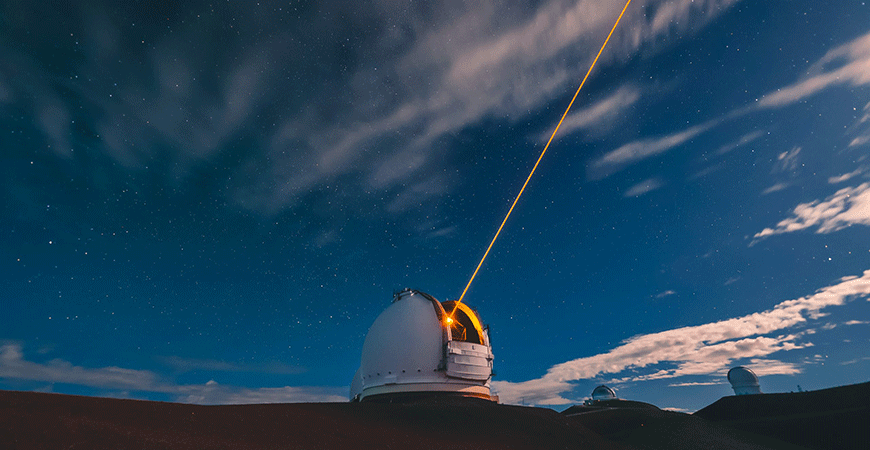
The findings come from MAGAZ3NE (the MAssive Galaxies at z ~ 3 NEar-infrared Survey), a long-running collaboration that uses spectroscopy and multi-wavelength observations to investigate how the most massive galaxies formed and evolved. The backbone of the MAGAZ3NE survey comprises more than 30 nights of spectroscopy obtained at the W. M. Keck Observatory, yielding precise redshifts and stellar mass measurements needed to interpret the multi-wavelength data.
According to the European Space Agency, “red shift” is a key concept for astronomers. The term can be understood literally: The wavelength of the light is stretched, so the light appears “shifted” toward the red region of the spectrum.
These new insights come from longer-wavelength far-infrared and radio observations, which are far better at probing dust emission, revealing vigorous star formation and active galactic nucleus activity that can be hidden from shorter-wavelength optical and near-infrared studies. An active galactic nucleus is a small region at the center of some galaxies that is far brighter than can be explained by the stellar population alone.
Using observations from the Atacama Large Millimeter/submillimeter Array (ALMA) and the Karl G. Jansky Very Large Array, the team directly tested whether massive galaxies previously classified as quiescent were truly inactive or instead hosting star formation or nuclear activity that is obscured at optical and near-infrared wavelengths.
“By combining multi-wavelength observations, we can tell which galaxies truly have limited ongoing star formation and which are still active but heavily hidden by dust,” Chang said. “Our far-infrared and (sub)millimeter measurements allow us to constrain how much dust these early massive galaxies contain.”
“What is striking is not just that we can detect hidden activity, but that we see such diversity among galaxies with similar masses at the same epoch,” Wilson said. “That tells us that the shutdown of star formation in the most massive galaxies was neither uniform nor simple, and it places important new constraints on our understanding of galaxy formation and evolution in the early universe.”
This research helps clarify whether UMGs in the early universe are “dusty or dead.” The researchers’ answer is not either-or. The results show that most of the UMGs studied are genuinely quiescent, indicating a rapid and efficient shutdown of star formation. Within this quiescent population, several systems are among the most dust-poor massive galaxies ever identified at these early cosmic times. The remaining two galaxies exhibit residual dust emission, with one showing evidence for ongoing but heavily obscured star formation, and the other caught in the process of quenching, or shutting down star formation.
These results offer a rare glimpse into the diverse evolutionary paths taken by the universe’s most massive galaxies.
“While optical and near-infrared data alone can severely underestimate obscured star formation in dusty massive galaxies, ALMA probes far-infrared wavelengths allowing improved constraints on the nature of these galaxies,” said Benjamin Forrest, a former postdoctoral scholar in Wilson’s research group and now a researcher at UC Davis. Forrest has played a central role in the development of the MAGAZ3NE survey and its multi-wavelength analysis of ultramassive galaxies. Forrest also led the proposal that resulted in many of the ALMA observations used in this study.
Members of the MAGAZ3NE collaboration involved in this work include Ian McConachie, postdoctoral researcher at the University of Wisconsin-Madison; Professor Allison Noble of Arizona State University; Professor Tracy Webb of McGill University; Professor Adam Muzzin of York University, Canada; Professor Michael Cooper of UC Irvine; Professor Gabriela Canalizo of UC Riverside; Professor Danilo Marchesini of Tufts University; Percy Gomez, staff astronomer at the W. M. Keck Observatory; and Stephanie Urbano Stawinski of UC Santa Barbara.
